You just got assigned to teach Spanish—and then you find out there’s no Spanish curriculum.
Maybe there’s no textbook. Maybe there are a few random worksheets left behind by the previous teacher. Or maybe you’ve been told, “Just use whatever you want!” and you’re wondering where on earth to start.
If this sounds familiar, you’re not alone. Many Spanish teachers, especially those teaching Spanish 1 or middle school Spanish, find themselves creating a curriculum from scratch while also trying to plan lessons, learn their students’ names, set up their classroom, and figure out what they’re supposed to teach next week.
The good news? You do not have to create everything from scratch.
In this post, I’ll walk you through how to start building a Spanish curriculum when you don’t have one—including how to decide what to teach, where to find a Spanish 1 scope and sequence, and how to turn that scope and sequence into manageable daily lessons.
I’ll also share some resources that can save you hours of planning time, whether you’re looking for a complete Spanish curriculum or simply need lesson plans and activities to fill in the gaps.
How to design a Spanish curriculum from scratch
When you have no textbook, designing a Spanish curriculum from scratch is crazy overwhelming. You could teach ANYTHING! To some people that feels totally liberating, but to me, it’s just too many choices. I want a guide.
As a middle school Spanish teacher, I decided to look to the high school to see what was taught in Spanish 1. What would my middle school Spanish students need to pass into Spanish 2 at the high school?
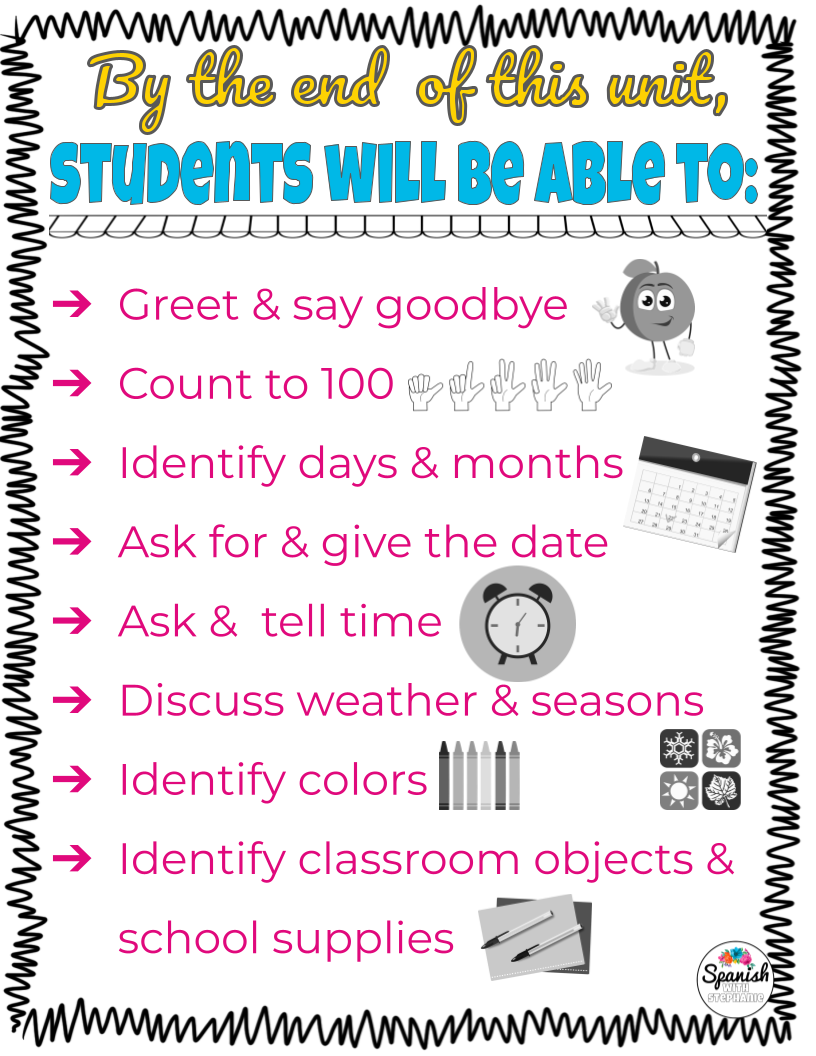
Using the high school Spanish 1 scope and sequence was the most logical way for me to prepare my students to continue with Spanish in the future. Therefore, I copied the scope and sequence of the high school, but slowed it down and spread it over 6th, 7th, and 8th grade. Here is what my first quarter included:
What if I am at a high school with no Spanish curriculum?
If you’re the only teacher in your department and there isn’t anyone else to reach out to, here are my scope and sequences. I’ve seen several different Spanish textbook series throughout my career and they usually all cover the same units, in their own unique order. Download these for free and use them as a guide.
Spanish 1 – Pretest before you plan
The first thing you’ll want to figure out is what do my students already know? If they are coming from another teacher, you’ll start the year with some review. I give my 7th grade students an ungraded pre-test with everything I expect them to remember from 6th grade Spanish. You can download my free beginning-of-year Spanish review test and then read this blog post about the quickest and best way to review. I knock out beginning of the year review within 2-3 class periods.
From there, look to see where the majority of the kids fell apart. That’s where you start. And if 80% or more of your class aced the pre-test, then look at your scope and sequence to see what comes next.
How do I write a Spanish curriculum that meets the needs of all my students?
If you teach Spanish 1, having a consistent structure can make your planning much easier.
Rather than starting from scratch every Sunday, you can use a year-long framework and then adjust individual lessons based on the pace and needs of your students.
My Spanish 1 lesson plan resources include daily and weekly planning materials that can help you organize your Spanish 1 curriculum. Here is an example from a later unit.
Like what you see? You’ll love how much time and energy you can save with these pre-made lesson plans for Spanish I and Spanish II. Every unit comes with everything you could possibly need to teach! You can print the step-by-step daily lesson plans and just use them, or modify them to fit your own classroom.
See what others are saying:


You don’t have to reinvent the wheel and write a Spanish curriculum from scratch. Give yourself permission to explore other options.